

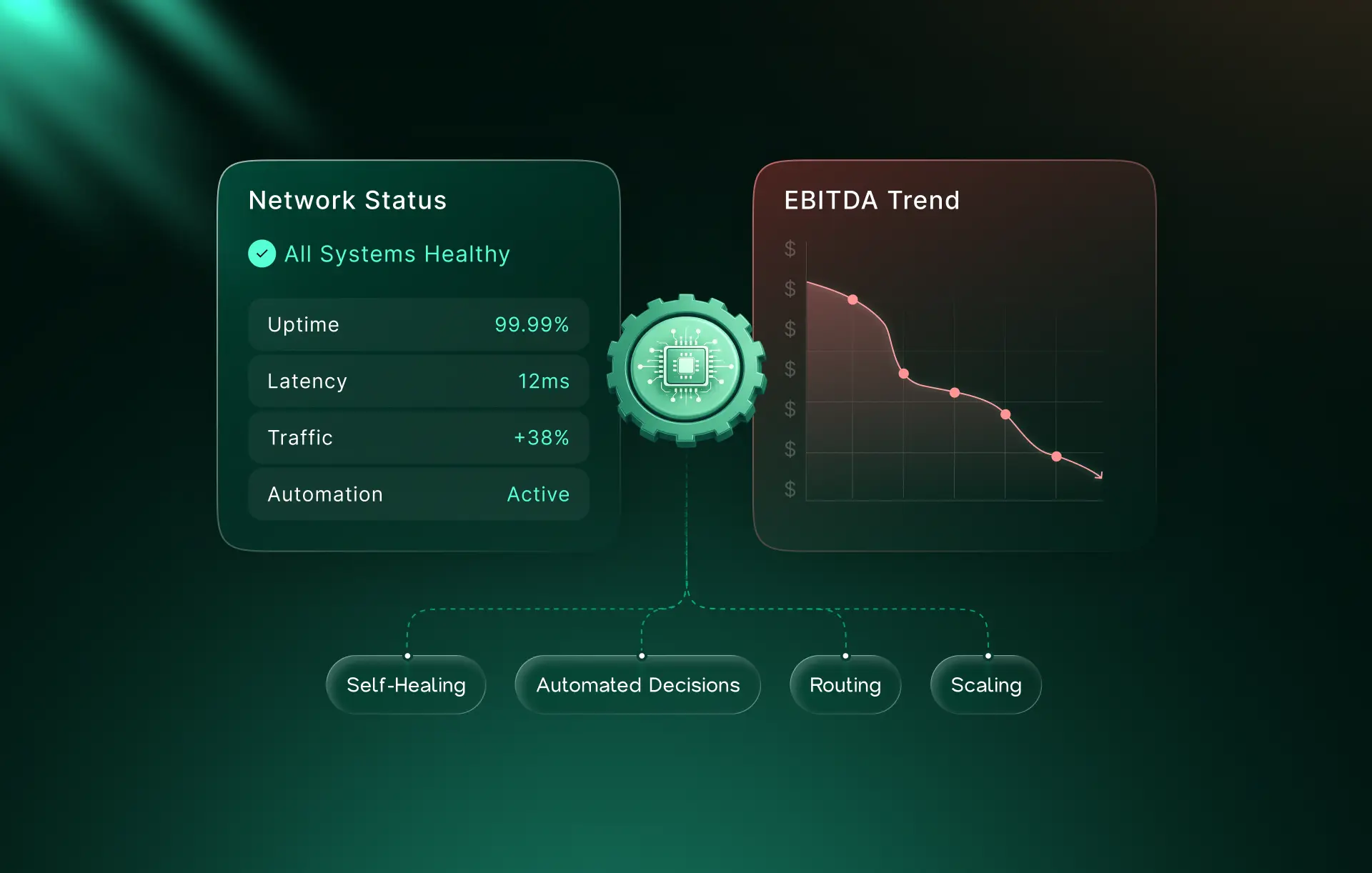
For most of telecom history, network performance was the proxy for business health. If uptime was high, latency was low, and traffic flowed, the operator was assumed to be performing well. That assumption no longer holds.
In 2026, telecom networks are more automated and resilient than ever. Yet operators across mature and emerging markets are reporting margin compression despite stable performance metrics. According to multiple industry benchmarks, telecom revenue growth is lagging traffic growth by a significant margin, while energy and infrastructure costs continue to rise.
Dashboards remain green. EBITDA does not. This is not a technical failure. It is an economic misalignment. Modern telecom systems are behaving correctly from a network perspective while drifting from a business perspective. That drift is becoming one of the most expensive structural issues operators face.
The Paradox Operators Are Living In
Automation now spans nearly every layer of the telecom stack.
Traffic is rerouted automatically. Capacity scales elastically. Faults are masked through self-healing orchestration. Edge workloads deploy dynamically. AI optimizes routing, quality of service, and congestion management in real time. On paper, these capabilities should lower operating costs. In practice, many operators are experiencing the opposite. Availability improves while baseline Opex increases.
Customer experience stabilizes while cost per delivered gigabyte rises. Automation expands while human oversight remains necessary. The network performs. The economics deteriorate. The root cause is straightforward. Modern systems aggressively optimize performance outcomes. They rarely optimize commercial outcomes with the same intensity. (Explore how structural price erosion is reshaping telecom margins.)
How Automation Quietly Changes Cost Behavior
Automation reduces direct human intervention. That is its core benefit. But automation also changes how cost accumulates. Consider what happens inside an AI-assisted network.
Traffic congestion triggers rerouting rather than escalation. Latency spikes are absorbed through additional compute allocation. Redundant paths maintain session continuity. Edge nodes scale to preserve experience. Each action is technically justified. Collectively, they establish a new operating baseline. Instead of surfacing inefficiency, the system absorbs it. Instead of forcing correction, automation masks friction. Over time, this results in a permanently elevated cost floor. Nothing fails. No alarms trigger. Costs become embedded in the architecture.
In markets where wholesale pricing is tightening and ARPU growth is stagnating, even incremental increases in baseline operating cost materially affect margins.
Why Traditional KPIs No Longer Reveal Economic Health
Most network KPIs were designed for availability-driven environments. They measure uptime, packet loss, latency thresholds, and SLA compliance.
They do not measure:
Cost per routing decision
Energy consumption per automated action
Margin impact of congestion handling
Wholesale exposure under retry logic
This is why operators can report high availability while finance teams report increasing cost intensity. Uptime confirms service continuity. It does not confirm economic sustainability.
In 2026, performance metrics alone are insufficient indicators of business health.
Where API and NaaS Strategies Break Financially
Network APIs and Network-as-a-Service were introduced to unlock programmable revenue. The promise was clear. Expose capabilities through standardized interfaces. Enable consumption-based billing. Monetize dynamically. Yet many API initiatives plateau after initial pilots.
The obstacle is rarely demand. It is financial clarity. Integration often requires telecom-specific expertise. Consumption units lack universal definitions. Pricing varies across markets and use cases. Enterprises require customization.
Sales teams compensate with bespoke agreements. Delivery becomes project-based. Provisioning involves manual oversight. Margins shrink under implementation complexity. What was designed as a scalable product model often reverts to managed service economics. (Discover how network APIs must evolve into product-driven revenue models.)
The missing ingredient is economic telemetry inside the network itself. Without visibility into cost per transaction or margin per API call, monetization strategies remain disconnected from operational reality.
Edge Computing Amplifies the Same Cost Pattern
Edge computing improves latency and enables distributed intelligence. Technically, it performs as designed. Economically, it introduces persistent infrastructure exposure. Compute remains active to avoid cold starts. Workloads stay resident to guarantee responsiveness. Energy consumption becomes continuous rather than elastic. Without cost-aware orchestration, edge environments establish a permanently active footprint regardless of demand quality. Operators gain technical performance. They inherit structural expense.
Again, the system behaves correctly from a network standpoint while drifting economically.
The Missing Layer: Economic Awareness in Network Decisions
Modern networks generate massive volumes of telemetry. Observability is not the issue. Economic context is. Automated systems optimize performance, availability, and utilization. Few evaluate cost per session, energy per transaction, or margin per automated decision in real time. This gap explains why automation often improves service quality without improving profitability.
When systems cannot quantify the financial consequence of their own behavior, efficiency becomes incidental rather than engineered. Scalability without economic awareness becomes fragile. (See how automation can become a growth engine when economics are built into the system.)
What Operators Must Redesign
This challenge is architectural. Operators must re-evaluate decision ownership. Which actions are automated and under what financial constraints? They must redesign feedback loops so economic signals influence operational behavior quickly, not at month-end. They must expand KPI frameworks to include cost-aware metrics alongside performance indicators.
They must introduce guardrails that define when performance should be traded for efficiency and when it should not. Without these adjustments, automation accelerates complexity and cost accumulation. With them, automation becomes a structural advantage.
The TelcoEdge Perspective
The next phase of telecom advantage will not come from more automation alone. It will come from automation that understands economic impact. Modern telecom does not fail technically. It drifts financially through thousands of technically correct decisions that compound cost. The operators who succeed will be those who embed economic intelligence directly into operational systems. In 2026, resilience is not defined by uptime. It is defined by the ability to scale without undermining profitability.
Telecom economics are under pressure not because networks are unreliable, but because automation has outpaced economic awareness.
Recognizing that gap is the first step toward building systems that perform efficiently, scale sustainably, and protect margin.